
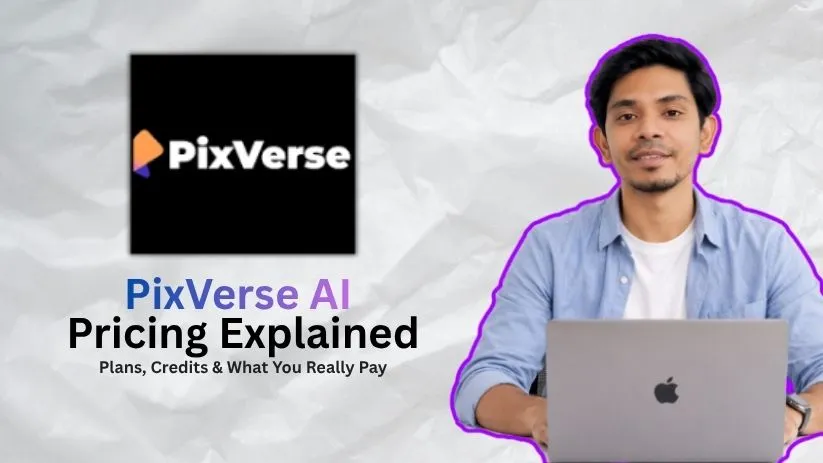
PixVerse AI pricing looks pretty affordable at first. But after generating a few videos, retrying prompts, and experimenting with higher-quality outputs, I realized the monthly subscription price only tells part of the story.
What really matters is how many credits you get and how quickly you use them. PixVerse has a free tier, while its main paid plans start at $10 per month and increase depending on your generation volume and workflow.
Want to know how the tool performs beyond the pricing page? Read my PixVerse AI review before deciding whether to subscribe.
PixVerse AI pricing plans: At a glance
PixVerse uses a credit-based pricing model. You receive a fixed number of monthly credits with paid subscriptions, while free users receive credits that refresh daily.
Here’s a quick look at the current PixVerse pricing plans:
| Plan | Monthly price | Annual price equivalent | Credits | Best for |
| Basic | $0 | $0 | 90 initial + 60 daily | Testing PixVerse |
| Standard | $10 | $8/month | 1,200/month | Casual creators |
| Pro | $30 | $24/month | 6,000/month | Regular creators |
| Premium | $60 | $48/month | 15,000/month | Heavy creators |
| Ultra | $199* | $149/month* | 25,000/month* | High-volume users |
PixVerse directly confirms monthly prices of $10 for Standard, $30 for Pro, and $60 for Premium. Recent pricing documentation reports the discounted annual rates and Ultra pricing shown above, but it’s still worth checking your PixVerse account before paying because plans and regional offers can change.
Not convinced PixVerse is the right fit? I’ve also compared the best PixVerse alternatives if you want to see what competing AI video generators offer for similar money.
PixVerse AI pricing plans breakdown
The cheapest plan isn’t automatically the best value. Resolution limits, monthly credits, generation speed, and how frequently you create videos matter just as much as the subscription price.
Here’s how each PixVerse AI pricing tier fits different types of users.
PixVerse Free plan: $0/month
The PixVerse free plan is actually useful for testing the platform rather than being a nearly unusable demo.
New users are currently reported to receive 90 initial credits, followed by 60 free credits each day. PixVerse’s official documentation confirms that daily credits refresh at 00:00 UTC and disappear if you don’t use them that day.
What’s included:
- 90 reported signup credits
- 60 daily credits
- Text-to-video generation
- Image-to-video generation
- Basic PixVerse creation tools
- Limited generation capacity
- Watermarked free outputs
Best for: Beginners who want to experiment with PixVerse before spending money.
Pros:
- No subscription required
- Fresh credits every day
- Enough to test real prompts and different ideas
Cons:
- Daily credits don’t roll over
- Limited generation volume
- Watermarks and free-tier limitations make it less practical for professional work
If your goal is to test several platforms before choosing one, my best AI video generator tools guide gives you more options to compare.
PixVerse Standard plan: $10/month
Standard is the cheapest paid PixVerse plan and probably the first option most casual creators will consider. It costs $10 monthly, or around $8 per month when billed annually, and includes 1,200 monthly credits.
The biggest limitation is resolution. Current pricing information lists Standard at up to 720p, so creators who routinely need higher-quality exports may outgrow it quickly.
What’s included:
- 1,200 monthly credits
- Up to 720p output
- Three concurrent generations
- Access to paid credit packs
- Preview Mode savings
- No need to rely only on daily free credits
Best for: Casual creators producing occasional TikTok, Instagram, Shorts, or experimental AI videos.
Pros:
- Low $10 entry price
- Much more predictable than relying on daily credits
- Enough capacity for occasional content creation
Cons:
- 720p resolution ceiling
- Monthly credits expire if unused
- Multiple retries can drain 1,200 credits faster than expected
If you’re comparing similarly priced AI video tools, check my guide to Vidu AI pricing before settling on Standard.
PixVerse Pro plan: $30/month
For regular creators, I think Pro is where PixVerse AI pricing starts making more sense.
The Pro plan costs $30 per month, dropping to a reported $24 per month with annual billing, and increases the allowance to 6,000 monthly credits. That’s five times Standard’s credits for three times the monthly price.
What’s included:
- 6,000 monthly credits
- Higher-resolution generation
- Five concurrent generations
- Batch Creation
- Off-peak credit savings
- Larger bonuses when purchasing extra credit packs
Best for: Freelancers, marketers, and creators generating AI videos every week.
Pros:
- Much stronger credit-to-price ratio than Standard
- Better suited to frequent retries and experimentation
- Higher resolution makes it more realistic for published content
Cons:
- Costs three times more than Standard
- Unused membership credits still expire at the end of the billing cycle
If realistic motion matters more to you than fast experimentation, also compare the current Hailuo AI pricing.
PixVerse Premium plan: $60/month
Premium doubles the Pro subscription price to $60 per month, while increasing the monthly allowance to 15,000 credits. Recent pricing data lists annual billing at the equivalent of about $48 per month.
This tier makes more sense when AI video generation has become part of your daily workflow rather than something you use occasionally.
What’s included:
- 15,000 monthly credits
- Higher generation capacity
- Up to eight concurrent generations
- Batch Creation
- Larger credit-pack bonuses
- Greater off-peak savings
Best for: Daily creators, marketers, and small teams producing a steady stream of AI video.
Pros:
- Significantly more monthly credits
- Better for high-volume experimentation
- More efficient for creators generating many variations
Cons:
- $60/month is difficult to justify for occasional use
- Credits can still disappear at the end of the billing period if you don’t use them
You can also compare DeeVid AI pricing if you’re looking for another AI video platform aimed at frequent content creation.
PixVerse Ultra plan: around $199/month
Ultra sits at the high-volume end of the consumer lineup. Recent pricing data lists it at $199 monthly, or around $149 per month with annual billing, with approximately 25,000 monthly credits.
Its value isn’t just the larger credit allowance. Higher-tier benefits such as heavier off-peak savings can matter considerably if you generate videos every day.
What’s included:
- Around 25,000 monthly credits
- High generation concurrency
- Batch Creation
- Larger credit-pack bonuses
- Maximum off-peak savings
- Higher-volume generation workflow
Best for: Heavy creators and production workflows that continuously generate large numbers of clips.
Pros:
- Built for serious generation volume
- Off-peak generation can improve its real value considerably
Cons:
- Expensive for individual creators
- Poor value if you don’t consistently use the available capacity
At this price point, I’d compare it with production-focused options before subscribing. My LTX Studio pricing guide is a useful place to start.
How PixVerse credits work
Understanding PixVerse credits is more important than simply comparing monthly prices. Every generation uses credits, and the amount you burn depends on what you’re creating and how often you retry it.
The good news is that PixVerse separates its credits into three types, and they don’t all expire in the same way.
Daily vs monthly vs purchased credits
PixVerse currently uses daily credits, monthly membership credits, and purchased credits.
- Daily credits: Refresh every day at 00:00 UTC and expire if you don’t use them.
- Monthly credits: Refresh with your billing cycle, and unused credits expire when that billing period ends.
- Purchased credits: Paid subscribers can buy additional credits, and these don’t expire until you use them.
PixVerse’s official billing FAQ confirms these expiration rules, so it makes sense to use your daily and monthly allowance before relying on purchased credits.
That also means buying a bigger plan isn’t automatically better. If you finish the month with thousands of unused membership credits, you’re paying for generation capacity you never actually needed.
How fast do PixVerse credits run out?
This is where PixVerse AI pricing gets more complicated.
PixVerse’s current web billing documentation says a video generation can consume 20, 40, or 60 credits, depending on the generation option. Text-to-video, image-to-video, and upscaling all use credits.
Retries matter too. If you generate a clip and don’t like the result, hitting retry consumes the same number of credits again. PixVerse says credits aren’t deducted when a generation actually fails to process.
So don’t calculate PixVerse cost per video using only your first generation.
If you need three attempts before getting a clip you would actually publish, your real cost is closer to three generations than one. Higher output requirements can make those credits disappear surprisingly quickly.
This is why I would judge a plan by usable videos per month, not simply the headline number of credits.
PixVerse credit packs and API pricing
If your monthly allowance runs out, paid subscribers can purchase extra PixVerse credit packs instead of immediately upgrading their subscription. Because purchased credits don’t expire, they’re useful when your workload occasionally spikes.
But don’t confuse these consumer credits with PixVerse API pricing.
PixVerse’s API Platform is billed separately from the web app, and API credits can’t be used with your regular PixVerse web membership.
The current API plans start much higher:
- Essential: $100/month for 15,000 credits
- Scale: $1,500/month for 239,230 credits
- Business: $6,000/month for 1,069,500 credits
API credit consumption also changes by model, resolution, video length, and whether you generate audio. For example, PixVerse’s current V6 API pricing charges more per second at 1080p than at 360p or 720p.
For most individual creators, these API plans aren’t relevant. They’re aimed more at developers and businesses building PixVerse video generation into their own products or automated workflows.
If you’re comparing credit-based creative tools before committing, you can also check my Krea AI pricing breakdown.
Which PixVerse plan should you choose?
The right PixVerse pricing plan depends less on features you might use and more on how frequently you actually generate videos.
Choose Free if you:
- Are trying PixVerse for the first time
- Only generate occasionally
- Don’t mind free-tier limitations
- Want to test prompts before subscribing
There’s little reason to pay immediately if you’re still figuring out whether you like PixVerse’s output.
Choose Standard if you:
- Create occasional short-form videos
- Want the cheapest paid PixVerse plan
- Need more predictable credits than the free tier
- Don’t generate enough to justify Pro
Standard makes sense for light use, but frequent retries can make its smaller credit allowance feel restrictive.
Choose Pro if you:
- Generate AI videos every week
- Regularly test multiple variations
- Need more generation capacity
- Want better value per monthly credit
For most serious individual creators, Pro looks like the practical sweet spot in the current PixVerse AI pricing lineup.
Choose Premium or Ultra if you:
- Generate videos almost every day
- Produce many variations for clients or campaigns
- Regularly burn through thousands of credits
- Care more about throughput than keeping your monthly bill low
These plans only become good value when you actually use the extra capacity.
Is PixVerse worth the cost?
PixVerse can be good value, especially if your main goal is creating short AI-generated clips quickly. But its real value depends on how many attempts you typically need before getting an output you’re happy with.
PixVerse is worth it if you:
- Regularly create short social-media videos
- Use text-to-video or image-to-video often
- Like experimenting with multiple visual ideas
- Can manage your monthly credit usage
- Value fast generation and iteration
PixVerse also supports tools such as transitions, extensions, sound, speech, restyling, and character features, which can make it more useful than a basic text-to-video generator.
Skip PixVerse if you:
- Mainly need long-form video production
- Frequently require many expensive retries
- Want a full professional video-editing environment
- Only generate a few videos every month
In that situation, even the cheaper PixVerse pricing plans may not be the best use of your budget. The subscription price matters, but the number of finished videos you can actually use matters more.
PixVerse alternatives & pricing comparison
PixVerse is competitively priced, but price alone shouldn’t decide which AI video generator you use. Kling, Runway, Pika, and Luma all approach credits, generation quality, and creative control differently.
Here’s a quick comparison of the main PixVerse alternatives:
| Tool | Starting paid price | Best for | Key advantage |
|---|---|---|---|
| PixVerse | $10/month | Fast short-form videos | Generous credits for the price |
| Kling AI | Around $10/month* | Cinematic realism | Strong motion and visual quality |
| Runway | $15/month | Professional creative workflows | Generation plus advanced creative tools |
| Pika | $8/month annually | Social and creative effects | Easy, fast experimentation |
| Luma AI | $30/month | Multi-model creative workflows | Video generation plus broader AI creation |
*Kling frequently runs introductory discounts, so the price shown in your account can be lower than its normal monthly list price.
Runway currently charges $15 monthly for Standard, while Pika advertises Standard at $8 per month with annual billing. Kling’s current published pricing shows a roughly $10 Standard list price with promotional discounts, and Luma’s newer creative platform starts its individual paid offering at $30 per month.
If your priority is getting plenty of short AI video generations without immediately moving into expensive professional plans, PixVerse remains one of the easier options to justify.
PixVerse vs Kling vs Runway vs Pika: Which should you choose?
Choose PixVerse if you want fast text-to-video and image-to-video generation, plenty of experimentation, and a relatively low starting price.
Choose Kling if realistic motion and cinematic-looking clips matter more than generation speed. Its paid tiers also offer higher-resolution generation and commercial-use benefits.
Choose Runway if AI video is part of a larger professional workflow. Standard starts at $15 monthly with 625 credits, while higher tiers provide considerably more generation capacity and model access.
Choose Pika if you mainly want quick social content and creative effects without a steep learning curve. Its paid plans support higher resolutions, watermark-free downloads, and commercial use.
For pure price-to-generation value, I’d start with PixVerse. For cinematic realism or more advanced production workflows, I’d compare Kling and Runway before paying.
My bottom line on PixVerse AI pricing
PixVerse AI pricing is reasonable, but the $10 starting price isn’t the number I would focus on most.
The Free plan is useful for testing, Standard works for occasional creators, and Pro looks like the strongest middle ground if you’re generating videos regularly. Premium and Ultra make more sense once AI video becomes part of your daily workflow.
The bigger lesson is to budget for usable clips, not first attempts. If one finished video requires three or four generations, that’s the number that should determine whether your PixVerse plan is actually good value.
Frequently asked questions
Is PixVerse AI free?
Yes. PixVerse AI is free to try, and its current app documentation says free accounts receive 60 credits each day. Those daily credits reset at 00:00 UTC and don’t carry over if you leave them unused.
For occasional experimentation, that can be enough. Regular creators will probably need one of the paid PixVerse pricing plans.
How much does PixVerse AI cost per month?
The main current PixVerse AI pricing tiers are Standard at $10 per month, Pro at $30 per month, and Premium at $60 per month. PixVerse directly confirms these three subscription prices.
Higher-volume tiers and promotional or annual prices can change, so check the subscription page inside your account before paying.
How many free credits does PixVerse give?
PixVerse currently gives free users 60 daily credits, which refresh every day at 00:00 UTC. Any unused daily credits expire instead of accumulating for future use.
That makes the free plan better for consistent small experiments than saving credits for one large project.
Do PixVerse credits roll over?
It depends on the type of credit.
Daily credits expire each day, while unused monthly membership credits expire at the end of your billing period. Purchased credits, however, don’t expire and stay in your account until you use them.
That’s one reason PixVerse credit packs can make more sense than upgrading when you only occasionally exceed your monthly allowance.
Can I use PixVerse AI videos commercially?
This one deserves extra attention. PixVerse’s current general Terms of Service says outputs are limited to non-commercial purposes unless you have the necessary authorization or commercial-use license. However, its separate Platform Terms state that commercial use of AI-generated content isn’t restricted.
Because those published terms aren’t completely aligned, I wouldn’t assume commercial rights based only on your subscription tier. Check the terms that specifically apply to your account and content before using PixVerse generations in client work, advertising, or other commercial projects.