
Apollo.io is a popular B2B sales intelligence and sales engagement platform built to help businesses find prospects, enrich contact data, and manage outbound campaigns from one place. Its database, search filters, automation tools, and CRM integrations make it a strong option for sales teams of different sizes.
But the main question is whether Apollo pricing offers good value for what you get. With four plans ranging from Free to Organization, plus different credit limits and feature restrictions, the actual cost can vary depending on how your team uses the platform.
Apollo also offers a 14-day free trial for paid plans, giving users a chance to test the platform before committing.
In this article, I’ll break down Apollo’s pricing plans, credits, features, extra costs, and overall value to help you decide which plan is right for your business.
Let’s get started.
How Much Does Apollo Cost? Quick Answer
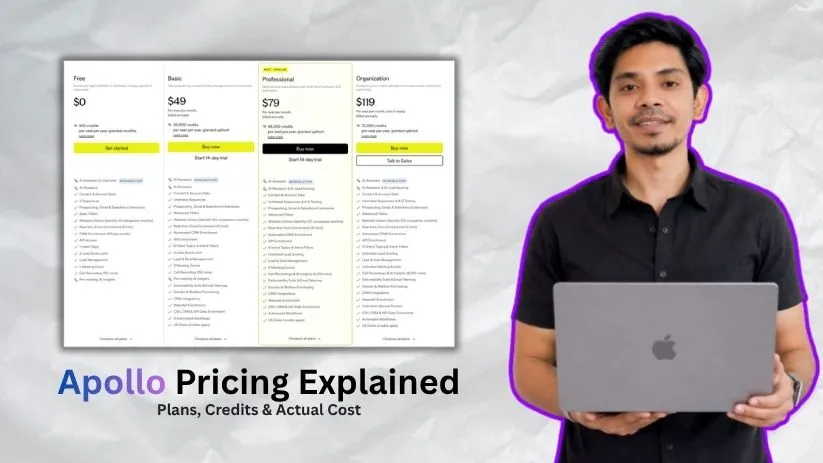
Apollo has four main pricing plans, from a free option for light prospecting to an Organization plan for larger teams.
Apollo Pricing Summary
| Plan | Price | Credits | Best For |
| Free | $0 | 900 credits/year | Testing Apollo and occasional prospecting |
| Basic | $49/user/month, billed annually | 30,000 credits/year | Individuals and small teams |
| Professional | $79/user/month, billed annually | 48,000 credits/year | Growing teams with heavier prospecting needs |
| Organization | $119/user/month, billed annually | 72,000 credits/year | Larger teams needing higher limits and controls |
Apollo uses credits for prospecting, enrichment, and research, so value depends on usage. Basic suits solo users and small teams, Professional fits heavier outreach, and Organization is built for larger teams needing higher limits and controls.
If contact data matters more than Apollo’s engagement features, compare the best Apollo.io alternatives.
Apollo Pricing: Detailed Plan Comparison
Apollo Free Plan — $0
Apollo Free costs $0 and includes 900 credits per seat per year, distributed monthly. It gives users access to Apollo’s core prospecting tools without a paid subscription.
| Feature | Details |
| Price | $0 |
| Credits | 900/year per seat |
| Sequences | 2 |
| Search Filters | Basic |
| Buying Intent | 1 topic |
| Website Visitors | 20 companies/month |
| Meeting Events | 1 |
| Call Recording | 150 minutes |
| API Access | Included with limits |
You can search Apollo’s contact and company database, use basic filters, create two sequences, and test limited intent and visitor data.
The main limitation is scale. With only 900 annual credits and tighter limits on sequences, enrichment, meetings, and intent data, the Free plan becomes restrictive once prospecting becomes regular.
When Should You Upgrade From Free?
Upgrade when you hit credit limits, need more than two sequences, want advanced filters, or require stronger CRM and enrichment capabilities.
Apollo Basic Plan — $49/Seat/Month Annually
Apollo Basic costs $49 per user per month when billed annually and includes 30,000 credits per seat per year.
| Feature | Details |
| Price | $49/user/month annually |
| Credits | 30,000/year |
| Sequences | Unlimited |
| Search Filters | Advanced |
| Buying Intent | Up to 6 topics |
| CRM Integrations | Included |
| Waterfall Enrichment | Included |
| Email Deliverability Tools | Included |
| US Dialer | Available with applicable credit usage |
Basic unlocks unlimited sequences, advanced filters, CRM integrations, waterfall enrichment, deliverability tools, and more intent topics.
Pro Tip: Basic is Apollo’s practical entry point for small teams that prospect regularly but do not yet need advanced AI, analytics, or enterprise controls.
Apollo Professional Plan — $79/Seat/Month Annually
Professional costs $79 per user per month when billed annually and includes 48,000 credits per seat per year.
| Feature | Details |
| Price | $79/user/month annually |
| Credits | 48,000/year |
| AI Research | Included |
| A/Z Testing | Included |
| Lead Scoring | Unlimited |
| Call Recording | Included |
| AI Call Insights | Included |
| Automated Workflows | Included |
| Reports & Analytics | Advanced |
| Email Mailboxes | Unlimited Gmail/Microsoft mailboxes |
Professional adds AI research, calling, workflow automation, analytics, testing, lead scoring, and call recording.
The upgrade makes sense if your team will use AI research, automated workflows, lead scoring, calling, and advanced analytics. If you mainly need prospect data and email sequences, Basic may offer better value.
For teams where automation is the priority, my n8n alternatives guide covers platforms built specifically around workflows.
Apollo Organization Plan — $119/Seat/Month Annually
Apollo Organization costs $119 per seat per month when billed annually and requires at least three seats. That creates a minimum base cost of $357 per month before extras or taxes.
| Feature | Details |
| Price | $119/user/month annually |
| Minimum Seats | 3 |
| Minimum Base Cost | $357/month |
| Credits | 72,000/year per seat |
| Buying Intent | Up to 12 topics |
| Meeting Events | Unlimited |
| Call Recording | Up to 8,000 minutes |
| Reporting | Customizable reports and dashboards |
| Salesforce | Custom object support |
| Security | SSO and advanced controls |
Organization adds higher limits, advanced security, administration, and customized reporting. Small teams are unlikely to justify the extra cost unless security, reporting, or administration requirements make those features necessary.
What Apollo Credits Actually Buy
Apollo’s price depends on more than the seat fee because credits are used for contact access, enrichment, AI research, exports, and some calling features.
| Team Type | Typical Usage | Best-Fit Plan | Cost |
| Light prospecting | Occasional contact lookups | Free | $0 |
| Email-first outreach | Regular list building | Basic | $49/seat/month |
| Email + enrichment | Prospecting and automation | Professional | $79/seat/month |
| High-volume team | Heavy prospecting and calling | Organization | $119/seat/month |
Actual credit use varies by workflow. A solo rep may find Basic sufficient, while a team doing frequent enrichment and research may use credits much faster. Credit allowance is therefore an important part of Apollo’s real cost. Pricing can therefore vary significantly by team usage.
Where Apollo Falls Short
Apollo offers a lot of value, but the platform becomes less predictable as your team grows and uses more advanced features.
- Credit tracking: Prospecting, enrichment, AI research, exports, and calling can make usage harder to estimate.
- Feature limits: Advanced automation, AI, analytics, and calling are reserved for higher-tier plans.
- Scaling costs: Adding more users increases the bill quickly. Five Professional seats cost $395/month when billed annually.
Pro Tip: Apollo works best for teams that use both its data and engagement tools, but heavier usage can make the total cost climb fast.
Best Apollo Alternatives
There are several strong Apollo.io alternatives to consider if you want a different approach to B2B data, enrichment, prospecting, or sales automation. Here are four options worth comparing.
Apollo vs Cognism
Cognism is a B2B sales intelligence platform focused on verified contact data, buyer intent, and compliant prospecting. Compared with Apollo, it is generally better suited to teams that place a higher priority on data quality and enterprise-level prospecting.
Key Features:
- Verified B2B contact data
- Buyer intent signals
- Phone-verified mobile numbers
- CRM integrations
- International prospecting
Still comparing Apollo with other sales intelligence tools? Check out the best Cognism alternatives before choosing a plan.
Apollo vs Clay
Clay takes a different approach. It is more focused on data enrichment, workflow automation, and combining information from multiple providers rather than acting as a traditional sales database.
Key Features:
- Multi-source data enrichment
- AI-powered research
- Workflow automation
- Personalization
- CRM and sales-tool integrations
Clay is a better fit than Apollo if you want more flexible enrichment and automation. See thebest Clay alternatives for more options.
Apollo vs BookYourData
BookYourData is aimed at users who mainly need B2B contact data without a large sales engagement suite. Apollo offers more built-in outreach and automation features, while BookYourData may appeal to teams looking for a more focused data solution.
Key Features:
- B2B contact database
- Email and phone data
- Targeted prospect lists
- Data filtering
- List building
Not sure Apollo’s credit model is right for your workflow? See the best BookYourData alternatives.
Apollo vs D7 Lead Finder
D7 Lead Finder is built around finding local business leads and contact information. It is simpler than Apollo and is better suited to agencies, local lead generation, and businesses targeting specific geographic markets.
Key Features:
- Local business lead discovery
- Email and phone data
- Location-based searches
- Business information
- Prospect list building
If local prospecting is your main goal, see the best D7 Lead Finder alternatives.
FAQs About Apollo Pricing
Is Apollo.io free?
Yes. Apollo offers a Free plan at $0, with 900 credits per year. It is best for testing the platform, occasional prospecting, and very small outreach campaigns.
How much does Apollo.io cost?
Apollo pricing starts at $49 per user per month for Basic, $79 for Professional, and $119 for Organization when billed annually. The Organization plan requires at least three seats.
What is the best Apollo plan for small businesses?
For most small businesses, the Basic plan offers the best balance of price and features. It includes 30,000 credits per year, unlimited sequences, advanced filters, CRM integrations, and enrichment tools.
How do Apollo credits work?
Apollo uses a credit-based system for actions such as accessing contact data, enrichment, research, exports, and some calling features. The number of credits included depends on your plan, so heavier prospecting can increase the effective cost of using Apollo.