
Apollo.io combines prospecting data, enrichment, and outbound engagement in one platform, but that all-in-one setup will not fit every sales workflow. I compared seven Apollo.io alternatives across data quality, enrichment, outreach, pricing, and ease of use to see where each option makes more sense. Apollo itself currently combines contact data with sequences, email, calling, LinkedIn tasks, and other outbound tools.
Best Apollo.io alternatives: At a glance
If you want deeper enterprise data, more flexible enrichment, or stronger cold-email infrastructure, use this table to quickly narrow down the option that fits your outbound workflow.
| Alternative | Best for | Starting price | Key advantage vs Apollo |
| ZoomInfo | Enterprise data and buyer intent | Custom pricing | Deeper enterprise sales intelligence |
| Clay | Custom enrichment workflows | Free; Launch from $185/month | Multi-provider enrichment |
| Cognism | Compliant global prospecting | From $12,750/year | Compliance-focused contact data |
| Lusha | Fast contact lookup | Free plan | Simple browser-based prospecting |
| Snov.io | Budget-friendly all-in-one outbound | $39/month | Prospecting, verification, and campaigns |
| Instantly | High-volume cold email | $47/month | Email infrastructure and warm-up |
| UpLead | Verified B2B contacts | $99/month | Real-time contact verification |
1. ZoomInfo: Best for enterprise sales intelligence
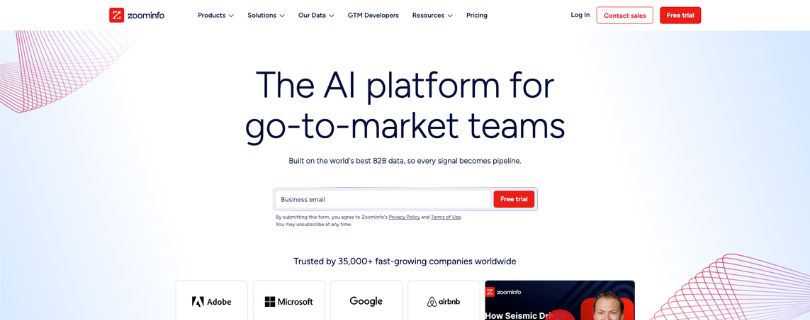
What does it do? ZoomInfo is a sales intelligence platform built around company and contact data, account insights, and buying signals.
Who is it for? Larger sales, marketing, and RevOps teams that need deeper account intelligence than a basic B2B prospecting tool provides.
ZoomInfo makes the most sense when your team wants more context before contacting an account. Instead of focusing mainly on finding an email or phone number, teams can use company intelligence and intent signals to help prioritize prospects.
That additional depth comes with a trade-off. ZoomInfo does not publish a standard paid rate, so you need to go through its sales process for pricing.
Where it beats Apollo
- Enterprise intelligence: Better suited to complex account-based sales motions where company-level intelligence matters.
- Buyer signals: A stronger fit for teams that want intent data to help decide which accounts to approach.
Pros
- Deep company and contact intelligence
- Useful buyer-intent signals
- Designed for larger revenue teams
Cons
- No straightforward public paid pricing
- More complexity than many small teams need
Pricing
ZoomInfo uses custom pricing rather than publishing a standard self-serve paid plan.
Bottom line
ZoomInfo is one of the stronger Apollo.io competitors for enterprise teams that prioritize account intelligence and intent over simple, lower-cost prospecting.
2. Clay: Best for custom data enrichment and GTM workflows
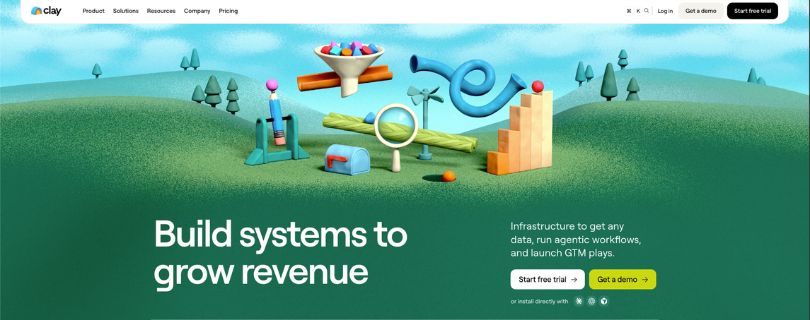
What does it do? Clay combines data enrichment, AI research, signals, and workflow automation inside a spreadsheet-style workspace.
Who is it for? RevOps teams, agencies, growth teams, and technical sellers that want to build customized prospecting workflows.
Clay takes a different approach from most Apollo.io alternatives. Rather than depending on one contact-data source, Clay can enrich records using 150+ providers and run multi-provider waterfalls to search across different sources.
That flexibility is useful when one provider cannot find every email, phone number, or company attribute you need. You can also combine enrichment with AI research and workflow logic instead of treating lead generation as a simple database search.
Where it beats Apollo
- Waterfall enrichment: Search multiple data providers in sequence instead of relying on one source.
- Workflow flexibility: Combine enrichment, AI research, signals, and integrations in custom workflows.
Pros
- 150+ data providers
- Multi-provider enrichment waterfalls
- Highly customizable GTM workflows
Cons
- Steeper learning curve
- Usage can become harder to predict as workflows grow
Pricing
Clay has a free plan. Its Launch plan currently starts at $185/month on monthly billing, with an effective rate around $167/month when billed annually.
Bottom line
Clay is the better fit when you want to design your own enrichment process rather than simply search a ready-made contact database.
Building more than prospecting workflows? Check out my guide to the best n8n alternatives for more workflow automation options.
3. Cognism: Best for compliant B2B prospecting

What does it do? Cognism is a sales intelligence software platform that provides company data, contact information, buying signals, and verified mobile numbers for B2B prospecting.
Who is it for? Mid-market and enterprise sales teams targeting international markets, particularly Europe.
Cognism stands out among Apollo.io alternatives because compliance is built directly into its data offering. The company says its database complies with GDPR and CCPA and is screened against 15 Do-Not-Call lists.
It also combines contact data with firmographics, technographics, hiring signals, job changes, and other context that helps sales reps understand an account before reaching out.
Where it beats Apollo
- Compliance-focused data: Strong DNC screening and privacy controls for international prospecting.
- European prospecting: A stronger focus on verified mobile data and EMEA coverage.
Pros
- Phone-verified mobile numbers
- GDPR and CCPA compliant
- Hiring, funding, and job-change signals
Cons
- Higher entry price than self-service tools
- No low-cost monthly plan for small teams
Pricing
Cognism’s Standard plan currently starts at $12,750 annually, while Pro starts at $17,000 annually. Both include five user seats.
Bottom line
Cognism is one of the more specialized Apollo.io competitors for teams that care about compliant international prospecting and verified mobile numbers.
4. Lusha: Best for fast contact lookup
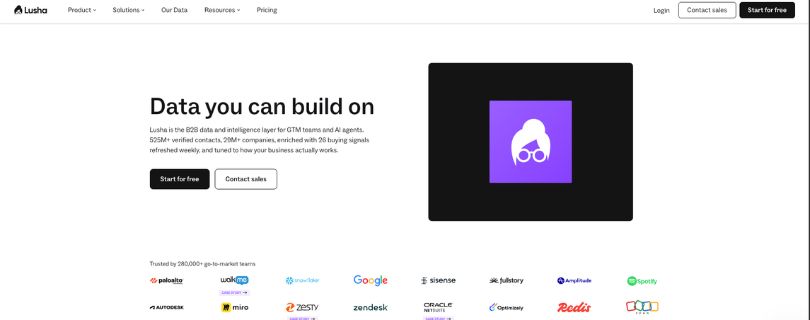
What does it do? Lusha helps sales reps find verified business emails, phone numbers, and company information through its prospecting workspace and browser extension.
Who is it for? Individual sales reps and smaller teams that want a straightforward B2B lead generation tool without adopting a complex sales platform.
Lusha is much simpler than Apollo. You can search for prospects or use the browser extension while researching companies and unlock only the contact details you actually need.
Its credit model is also easy to understand. Revealing a verified email costs one credit, while revealing a phone number costs five. Searches themselves don’t consume credits.
Where it beats Apollo
- Simple contact lookup: Less platform complexity when you mainly need emails and phone numbers.
- Browser workflow: Find prospect information without constantly switching between tools.
Pros
- Permanent free plan
- Browser extension included
- CRM integrations available
Cons
- Phone numbers consume credits quickly
- Less comprehensive than a full sales engagement platform
Pricing
Lusha’s free plan currently includes 40 credits per month with one seat and no credit card required. Paid self-service plans add larger credit allowances and team features.
Bottom line
Lusha makes sense if you want quick contact discovery without paying for features your team may never use.
Connecting prospect data to automated workflows? Read my guide explaining what n8n is and how workflow automation works.
5. Snov.io: Best budget-friendly all-in-one alternative
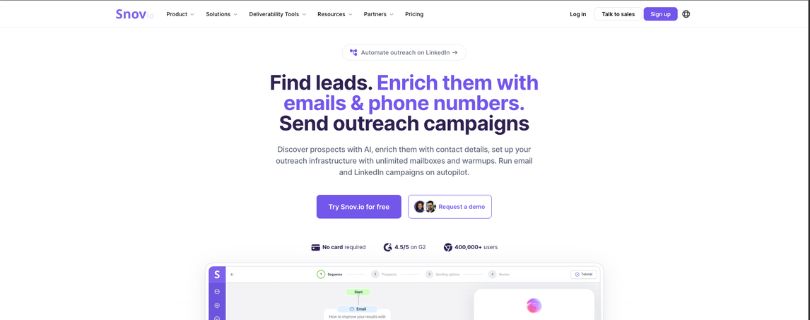
What does it do? Snov.io combines prospecting, email finding and verification, outreach campaigns, warm-up, and CRM tools.
Who is it for? Startups, small sales teams, and agencies that want affordable outbound sales software without stitching together several tools.
Snov.io is one of the closer Apollo.io alternatives if you still want an all-in-one workflow. You can find prospects, verify emails, build sequences, and manage outreach from the same platform.
Where it beats Apollo
- Affordable workflow: Prospecting, verification, campaigns, and warm-up sit under one subscription.
- Email-focused toolset: Useful if cold email matters more than deep enterprise intelligence.
Pros
- Built-in email finder and verifier
- Email warm-up included
- Free trial available
Cons
- Credits limit prospecting volume
- Higher volumes require costlier plans
Pricing
Snov.io Starter costs $39/month and includes 1,000 credits and 5,000 recipients. Pro plans start at $99/month.
Bottom line
Snov.io is a practical alternative to Apollo.io for smaller teams that want lead generation and outreach together without enterprise pricing.
6. Instantly: Best for high-volume cold email
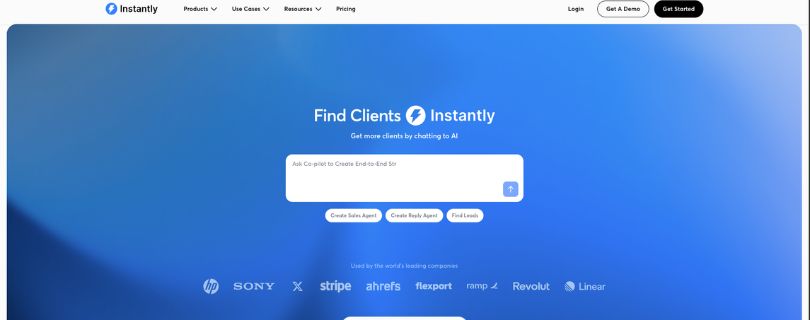
What does it do? Instantly handles cold-email sending, inbox warm-up, lead data, and reply management.
Who is it for? Agencies and outbound teams where sending volume matters more than a broad contact database software platform.
Instantly is more specialized than Apollo. Outreach plans include unlimited email accounts and warm-up, which helps teams spread campaigns across multiple sending inboxes.
SuperSearch provides prospect data, but Outreach, Credits, and CRM can be separate subscriptions. Your total cost depends on the stack you build.
Where it beats Apollo
- Cold-email infrastructure: Built around sending, warm-up, and deliverability.
- Mailbox scale: Unlimited email accounts across Outreach plans.
Pros
- Unlimited accounts and warm-up
- Built for scaled outreach
Cons
- Some features require separate subscriptions
- Costs rise as you add modules
Pricing
Outreach Growth currently costs $47/month.
Bottom line
Instantly is a strong Apollo competitor when cold email is the main job and you need infrastructure built to scale.
Comparing business AI costs too? Read my ChatGPT Business pricing update before expanding your software stack.
7. UpLead: Best for verified B2B contact data
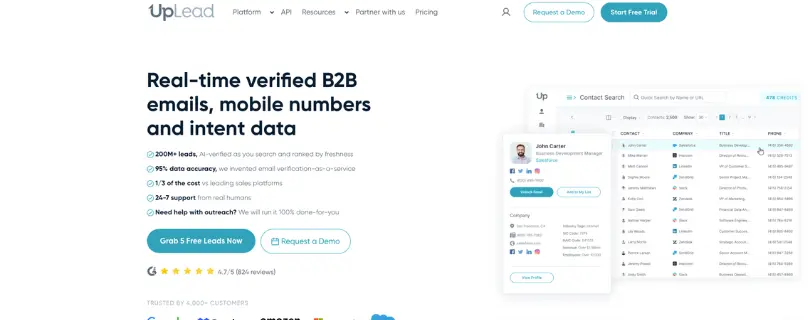
What does it do? UpLead is a B2B prospecting database with real-time email verification, mobile numbers, enrichment, and intent data.
Who is it for? Sales teams that prioritize verified contacts over having a complete sales engagement platform in the same product.
UpLead puts data quality at the center of its offer. It verifies emails in real time and advertises a 95% data accuracy guarantee—a figure published by UpLead rather than an independent test.
Its credit model is simple: one credit unlocks one contact for download or CRM export, including the available email and mobile direct dial.
Where it beats Apollo
- Verification-first approach: Emails are checked in real time.
- Simple credits: One credit unlocks one contact.
Pros
- Real-time email verification
- Mobile direct dials included
- 7-day free trial
Cons
- Lower plans are single-user
- No built-in email sequencing
Pricing
Essentials costs $99/month, or $74/month when billed annually.
Bottom line
UpLead suits teams looking for B2B prospecting tools where verified contact data matters more than built-in outreach automation.
How I compared these Apollo.io alternatives
I compared these Apollo.io alternatives based on the parts of outbound sales that matter most once you move beyond simply finding a prospect’s email address.
- Data quality: How contacts are verified and updated.
- Coverage: Emails, phone numbers, firmographics, and buying signals.
- Prospecting and enrichment: Search filters, enrichment, intent data, and workflow flexibility.
- Outreach: Email sequences, warm-up, deliverability, and CRM integrations.
- Pricing: Credits, user limits, and how costs change as your team scales.
The goal wasn’t to find seven tools that copy Apollo feature for feature. It was to identify which B2B prospecting tools make more sense for different outbound workflows.
Want more control over automated workflows? Check out my guide to the best n8n alternatives for more workflow automation platforms.
Which Apollo.io alternative should you choose?
The right option depends on whether your priority is better data, enrichment, compliance, or outbound email infrastructure.
- Choose ZoomInfo if you need enterprise-level account intelligence and buyer intent.
- Choose Clay if you want customizable enrichment across multiple data providers.
- Choose Cognism if compliance and international prospecting are priorities.
- Choose Lusha if you mainly need quick emails and phone numbers.
- Choose Snov.io if you want affordable prospecting and outreach in one platform.
- Choose Instantly if high-volume cold email is your main workflow.
- Choose UpLead if verified contact data matters more than built-in sequencing.
None of these Apollo.io alternatives is automatically better for every sales team. The best fit depends on which part of Apollo you are actually trying to replace.
Exploring AI-powered workflow builders too? See my guide to the best Google Opal alternatives before choosing your automation stack.
Frequently asked questions
What is the best alternative to Apollo.io?
It depends on the use case. ZoomInfo targets enterprise sales intelligence, Clay focuses on enrichment workflows, while Snov.io and Instantly are better suited to email-driven outbound.
Is there a free Apollo.io alternative?
Yes. Clay and Lusha both offer free access, while several other Apollo competitors provide trials or limited plans so you can test their data before committing.
Which Apollo.io alternative is best for cold email?
Instantly focuses heavily on cold-email infrastructure and sending scale. Snov.io is another option if you also want prospecting, email verification, and campaign tools in one platform.
What should I look for when replacing Apollo.io?
Start with data accuracy, geographic coverage, phone versus email availability, integrations, outreach features, and total cost. A cheaper sales engagement platform can become expensive if you regularly need extra credits or separate tools.