
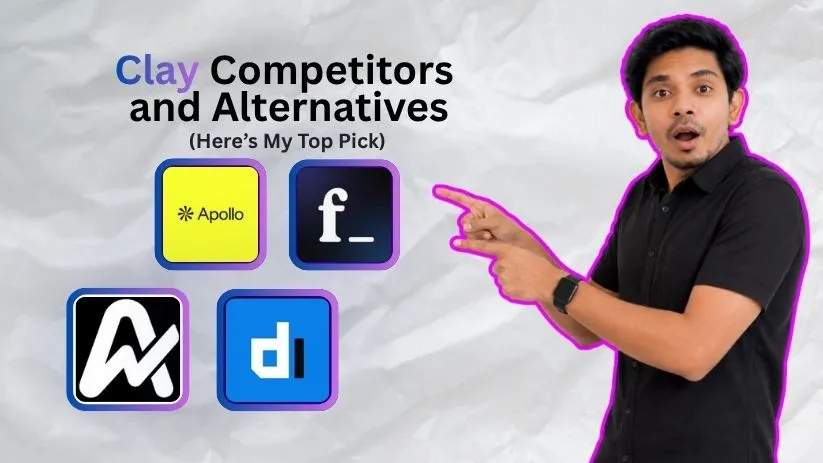
Clay is powerful when you want to combine data enrichment, AI research, and GTM automation in one flexible workspace. But that flexibility can also mean more setup, more moving parts, and a pricing model you need to understand before scaling.
I compared five Clay alternatives for teams that want a simpler way to find leads, enrich contact data, automate GTM workflows, or control what they spend.
The right choice depends on what you’re actually trying to replace.
5 Best Clay Alternatives: At a Glance
If you like what Clay can do but want something simpler, cheaper, or more focused on a particular workflow, use this table to quickly narrow down your options.
| Alternative | Best for | Starting price | Key advantage vs Clay |
| Apollo.io | All-in-one prospecting and outreach | Free; Basic from $49/user/month annually | Database, enrichment, and outreach in one platform |
| Freckle | Simple CRM enrichment | Free; paid plans from $99/month | Straightforward waterfall enrichment |
| Floqer | GTM automation and buying signals | Free; paid plans from $49/month | Signals, enrichment, and automation in one workflow |
| AirScale | Affordable bulk enrichment | From $49/month | 30+ data providers and rollover credits |
| Derrick App | Google Sheets users | Free; paid plans from €20/month | Lightweight enrichment directly inside Sheets |
Apollo’s Basic plan is currently $49 per user per month when billed annually, while Freckle’s Build tier starts at $99 per month. AirScale starts at $49 per month, and Derrick’s current paid plans start at €20 per month.
Why Look for a Clay Alternative?
Clay does much more than basic lead enrichment software. It can connect to more than 150 data providers, run multi-provider waterfalls, perform web research with Claygent, and let you bring your own API keys.
That flexibility is exactly why some teams love it.
But you might not need all of it.
If your main goal is finding prospects, enriching a CRM, getting verified contact details, or running a straightforward outbound campaign, a more focused tool can be easier to manage.
Pricing is another consideration. Clay separates platform Actions from Data Credits. Its Launch plan currently starts at $185/month on monthly billing, while Growth starts at $495/month.
That model gives experienced GTM teams plenty of control, but smaller teams may prefer B2B data enrichment tools with simpler pricing and fewer workflow decisions.
Some Clay competitors also bundle capabilities Clay approaches differently. Apollo combines prospecting data with outreach. AirScale concentrates heavily on enrichment. Derrick keeps much of the workflow inside Google Sheets.
So the goal isn’t necessarily to find a tool that copies every Clay feature.
It’s to find the Clay alternative that matches the part of Clay you actually use.
Still comparing workflow automation tools? Check out my guide to the best n8n alternatives.
1. Apollo.io: Best for All-in-One Prospecting and Outreach
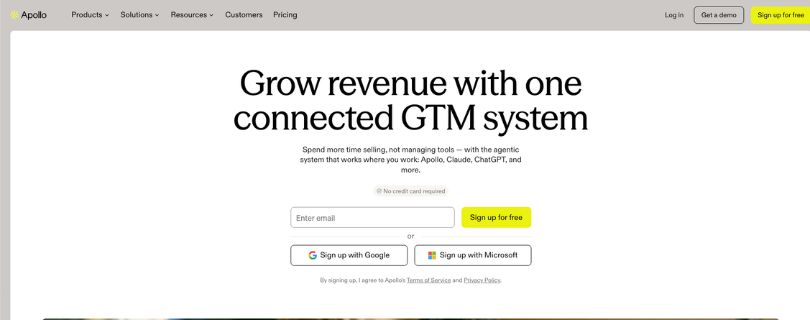
What does it do? Apollo is a sales intelligence platform that combines contact and company data, prospecting, enrichment, sequences, intent data, and sales workflows in one product. Its current plans also include waterfall enrichment.
Who is it for? Sales teams that would rather use one platform for finding prospects and contacting them than connect several separate tools together.
The biggest difference between Apollo and Clay is where each workflow starts.
With Clay, you can build highly customized enrichment workflows and decide which providers, signals, APIs, and AI steps should run.
Apollo is more opinionated.
You search its contact and account database, apply filters, enrich the people you want, and move them into sequences without leaving the same platform.
That makes it one of the more practical Clay alternatives for SDR teams that care more about prospecting and outreach than building custom GTM infrastructure.
Apollo’s free plan includes contact and account data, two sequences, basic filters, limited CRM enrichment, API access, and one intent topic. The Basic plan adds more prospecting and outreach capacity for $49 per user per month when billed annually.
Where Apollo beats Clay
- Built-in prospecting database: You can search for contacts and companies without first assembling a separate enrichment workflow.
- Outreach in the same platform: Build prospect lists and move them directly into email sequences.
- Lower setup barrier: Standard sales prospecting workflows require less configuration than a highly customized Clay table.
Pros
- Combines prospecting, enrichment, and outreach.
- Free plan available for testing the workflow.
- Built-in intent and company data.
- Works well for traditional SDR prospecting.
Cons
- Per-seat pricing can become expensive as the sales team grows.
- Less flexible than Clay for highly customized multi-provider enrichment workflows.
Pricing
Apollo has a free plan. Basic currently costs $49 per user per month billed annually, Professional costs $79, and Organization costs $119 per user per month with a three-user minimum.
Bottom line
Apollo makes the most sense if you want your sales prospecting tools, contact database, enrichment, and outbound sequences in one place instead of building each step separately.
2. Freckle: Best for Simpler CRM Enrichment
What does it do? Freckle is a data enrichment platform that combines multiple providers, web research, and CRM enrichment in one workflow.
Who is it for? Sales and RevOps teams that want Clay-style enrichment without spending as much time building tables, choosing providers, and managing complex workflows.
Freckle is one of the more straightforward Clay alternatives if your main goal is enriching existing leads rather than building a full GTM operating system.
You tell Freckle what data you need, and it works across multiple sources to fill in missing information. That makes it useful for CRM cleanup, lead enrichment, and completing contact or company records.
The main difference is control versus simplicity.
Clay gives you more control over providers, waterfalls, formulas, AI steps, and workflow logic. Freckle hides more of that complexity, which can make it easier for teams that mainly need CRM enrichment.
Where Freckle beats Clay
- Simpler setup: Less manual work when building basic enrichment workflows.
- CRM-focused workflow: Useful for cleaning and completing existing records.
- Lower learning curve: Easier to understand when enrichment is the main job.
Pros
- Multi-provider enrichment.
- Useful for CRM cleanup and missing data.
- Free plan available.
- Easier setup for straightforward workflows.
Cons
- Less flexible for highly customized GTM workflows.
- Not an all-in-one prospecting and outreach platform.
Pricing
Freckle has a free plan with 250 credits. Its Build plan starts at $99 per month and adds more capacity, integrations, and workflow features.
Bottom line
Freckle is a practical choice if you want lead enrichment software that removes some of Clay’s setup work and keeps the workflow focused on cleaner CRM data.
3. Floqer: Best for GTM Automation and Buying Signals
What does it do? Floqer combines contact and company enrichment with prospecting, buying signals, workflow automation, and CRM syncing.
Who is it for? GTM and RevOps teams that need enrichment, signals, and automation to work together.
Floqer is closer to Clay than some of the other tools here because it goes beyond basic enrichment.
You can build workflows around people and companies, enrich records across multiple sources, and use signals such as job changes, funding, and social activity to decide who should enter a sales workflow.
That makes it useful when your process starts with a trigger instead of a static spreadsheet.
For example, you could monitor a buying signal, enrich the matching accounts, push the results to your CRM, and trigger the next step without moving between several tools.
Floqer also supports APIs, webhooks, and MCP connections, giving technical teams more ways to connect enrichment with the rest of their sales stack.
Curious how MCP works in a real AI workflow? See what happened when I tested Rive MCP with Claude Code.
Where Floqer beats Clay
- Signals and enrichment together: Build workflows around buying signals instead of only static lists.
- Unlimited seats: Easier for larger GTM teams to collaborate.
- Automation focus: Enrichment, CRM sync, triggers, and workflows can stay connected.
Pros
- Multi-provider waterfall enrichment.
- Built-in GTM signals.
- CRM integrations, APIs, and webhooks.
- Free option for testing.
Cons
- Some advanced security and governance features require higher-tier plans.
- Overkill if you only need basic email or phone enrichment.
Pricing
Floqer offers a free starting option with 100 credits. Paid self-serve plans start at $49 per month.
Bottom line
Floqer makes sense if you are comparing GTM automation tools and want enrichment, signals, CRM syncing, and workflow automation in one system.
4. AirScale: Best for Affordable Bulk Data Enrichment
What does it do? AirScale is a B2B data enrichment platform that lets you find and enrich contact and company information across more than 30 data providers.
Who is it for? Sales teams, agencies, and RevOps users that already have prospect lists and mainly need reliable enrichment without building a complicated GTM workflow.
AirScale takes a more focused approach than Clay.
Instead of giving you a highly customizable workspace for enrichment, AI research, and automation, it concentrates on finding missing data and enriching lists at scale.
You can upload prospect lists, enrich existing records, work with multiple data sources, and export the results into the rest of your sales stack.
That makes AirScale particularly useful if you already know who you want to target.
You don’t necessarily need Clay’s full workflow builder when the job is simply taking a list of companies or people and finding better emails, phone numbers, and other useful data.
Another useful difference is credit management. AirScale allows unused credits to roll over, which can make spending easier to manage when your enrichment volume changes from month to month.
Where AirScale beats Clay
- Focused enrichment workflow: Less setup when your main goal is enriching existing lists.
- Multiple data providers: Access more than 30 providers without manually building every enrichment step.
- Credit rollover: Unused credits can carry forward instead of disappearing at the end of the billing cycle.
Pros
- Good for bulk B2B data enrichment.
- More than 30 enrichment providers.
- Unlimited users on paid plans.
- API access for connecting enrichment to other workflows.
- Unused credits roll over.
Cons
- Not as flexible as Clay for complex GTM automation.
- Less suitable if you want advanced AI research and highly customized workflow logic.
Pricing
AirScale’s Starter plan begins at $49 per month with 4,000 credits. Higher tiers increase the monthly credit allowance and add features for teams handling larger enrichment volumes.
Bottom line
AirScale is a strong cheaper alternative to Clay if your priority is bulk enrichment and you don’t need Clay’s broader workflow-building capabilities.
If your needs are closer to analytics than lead enrichment, check out my guide to the best Domo AI alternatives.
5. Derrick App: Best for Google Sheets and Lightweight Enrichment
What does it do? Derrick App helps you enrich prospect and company data through its web app, Google Sheets, and other connected workflows.
Who is it for? Freelancers, small sales teams, agencies, and spreadsheet-heavy users who want enrichment without moving their entire workflow into a dedicated GTM platform.
Derrick feels different from most Clay competitors because it doesn’t try to recreate Clay’s complete workspace.
Its biggest advantage is simplicity.
If most of your prospecting already happens inside Google Sheets, Derrick lets you add enrichment without constantly moving CSV files between different platforms.
You can use it to enrich LinkedIn profiles, find contact information, add company details, and work with prospect lists directly from a familiar spreadsheet workflow.
That can be enough for smaller outbound teams.
Clay gives you much deeper control over waterfall enrichment, AI research, custom formulas, integrations, and multi-step workflows. Derrick is more attractive when you don’t need that level of infrastructure.
It also supports options such as API and MCP access on appropriate plans, making it possible to connect enrichment with broader AI workflows as your setup grows.
Building AI workflows for a team? Read my breakdown of ChatGPT Business pricing and workspace agents.
Where Derrick beats Clay
- Google Sheets workflow: Enrich data without leaving the spreadsheet environment many sales teams already use.
- Lower barrier to entry: Easier to understand for users who don’t want to build complex enrichment tables.
- Lightweight setup: Useful when you mainly need contact and company data rather than an entire GTM automation platform.
Pros
- Works with Google Sheets.
- Free plan available.
- Simple interface for smaller enrichment jobs.
- API and MCP options for more advanced workflows.
Cons
- Much less powerful than Clay for complex automation.
- Not designed to replace a complete sales engagement platform.
Pricing
Derrick has a free plan with 100 monthly credits. Its Standard plan starts at €20 per month with 10,000 credits, while the Plus plan costs €47.50 per month.
Bottom line
Derrick is one of the most approachable Clay.com alternatives if you primarily work in spreadsheets and want enrichment without learning a more complex GTM platform.
How I Evaluated These Clay Alternatives
I didn’t compare these tools based only on how many features appear on their pricing pages.
The more useful question is how well each one handles the job people normally use Clay for.
Here’s what I focused on:
- Data quality: Can the tool find useful emails, phone numbers, company details, and other prospect information?
- Enrichment depth: Does it rely on one database or support multi-provider waterfall enrichment?
- Ease of use: How much setup does it take before a sales or RevOps user can get useful results?
- Workflow and integrations: Can it connect enrichment with CRM systems, APIs, webhooks, and other GTM automation tools?
- Pricing predictability: Can you estimate what a real workflow will cost, or does heavy enrichment make usage difficult to predict?
These criteria also help separate a true Clay replacement from a tool that only replaces one part of Clay.
Still exploring no-code AI workflow builders? See my guide to the best Google Opal alternatives.
Which Clay Alternative Should You Choose?
The best Clay alternative depends on which part of Clay you actually want to replace.
Choose Apollo.io if you want prospecting, contact data, enrichment, and outbound sequences inside one sales platform.
Choose Freckle if your priority is simple CRM enrichment without spending as much time configuring providers and workflows.
Choose Floqer if you need enrichment, buying signals, and GTM automation working together.
Choose AirScale if you already have prospect lists and mainly want affordable bulk enrichment from multiple data providers.
Choose Derrick App if most of your prospecting happens in Google Sheets and you want a lightweight enrichment workflow.
Stay with Clay if you need highly customizable waterfall enrichment, AI research, multiple data providers, and complex workflow logic.
New to workflow automation? Read my guide on what n8n is and how it works before deciding whether you need a dedicated GTM platform.
When Does It Still Make Sense to Use Clay?
Not every team searching for Clay competitors should actually leave Clay.
Clay still makes sense when you want to combine multiple enrichment providers, custom formulas, AI research, external APIs, and automation inside the same workflow.
It is particularly useful when your enrichment process has several conditional steps.
For example, you might search one provider for an email, fall back to another if nothing is found, research the company with AI, qualify the account, and then send the result to your CRM.
A simpler sales intelligence platform may be easier to use, but it may not give you that same level of control.
So if your team already has mature Clay workflows that work well, switching purely to save on the monthly subscription may create more work than it removes.
Interested in building AI workflows without a traditional GTM platform? My guide to Google Opal AI explains another approach to no-code AI automation.
Final Thoughts
There isn’t one Clay alternative that is better for every team.
Apollo works well for all-in-one sales prospecting, Freckle keeps enrichment simple, Floqer focuses on GTM automation and signals, AirScale is useful for bulk enrichment, and Derrick keeps things lightweight for spreadsheet users.
The best option is the one that replaces the part of Clay you actually need without making the rest of your workflow more complicated.
Want to understand the AI models behind more advanced automation workflows? See my GPT-5.6 Sol guide.
Frequently Asked Questions
What is the best free alternative to Clay?
Apollo, Freckle, Floqer, and Derrick all offer free ways to start, but they solve different problems.
Apollo is useful if you need a prospect database and outreach tools. Freckle focuses more on enrichment, while Floqer combines enrichment with GTM workflows and signals. Derrick is useful for smaller spreadsheet-based workflows.
What is the cheapest Clay alternative?
Derrick is one of the lowest-cost paid options in this list, with plans starting at €20 per month.
However, the cheapest subscription is not always the cheapest tool to operate. Look at how credits are consumed, how many records you enrich, and whether you need additional providers.
Which Clay alternative is closest to Clay?
Floqer is one of the closer options in this list if you’re looking for a combination of enrichment, signals, integrations, and GTM automation tools.
AirScale and Freckle are more focused on enrichment, while Apollo approaches the problem as an all-in-one sales platform.
If you’re exploring AI agents as part of your automation stack, check out my breakdown of Claude Sonnet 5.
Is Apollo better than Clay?
They are built around different workflows.
Apollo makes more sense when you want a built-in prospect database, enrichment, and sales engagement in one place. Clay gives you more flexibility when you want to combine different data providers, AI research, and custom enrichment logic.
Can I replace Clay with n8n?
You can use n8n to automate parts of a Clay-style workflow by connecting APIs, databases, CRMs, enrichment providers, and AI models.
But n8n is primarily a workflow automation platform, so you normally need to bring your own data sources and configure more of the system yourself.
Want to see more ways AI agents can work inside business tools? Read my guide to the Claude Tag Slack AI agent.