
“Why does building a simple app still feel so complicated?”
That is a question a lot of people ask after hitting setup walls, broken dependencies, and tools that promise simplicity but deliver frustration. You have an idea, maybe even a clear use case, yet turning it into a working app feels out of reach unless you know how to code or hire someone who does.
Lovable AI is built to change that experience.
It offers a smarter way to build your own apps without coding. Instead of learning frameworks or stitching together tools, you describe what you want in plain language. Lovable turns that description into a working application, handling the frontend, backend, and setup behind the scenes.
This does not mean software development disappears. It means the technical heavy lifting moves out of your way. You focus on the idea and behavior of the app, while Lovable handles the implementation.
This guide breaks down how Lovable AI works, its tech stack, use cases, pricing, strengths, limitations, and whether it is worth using.
What Is Lovable AI?
Lovable AI turns plain English app ideas into working web applications. It allows people to build fully functional, dynamic apps without going through the traditional complexity of full stack development.
Instead of manually handling frontend code, backend logic, and infrastructure setup, Lovable AI acts as a full stack app builder. It generates both the client and server side of an application automatically, helping users move from idea to working product much faster.
In practice, that means Lovable can create:
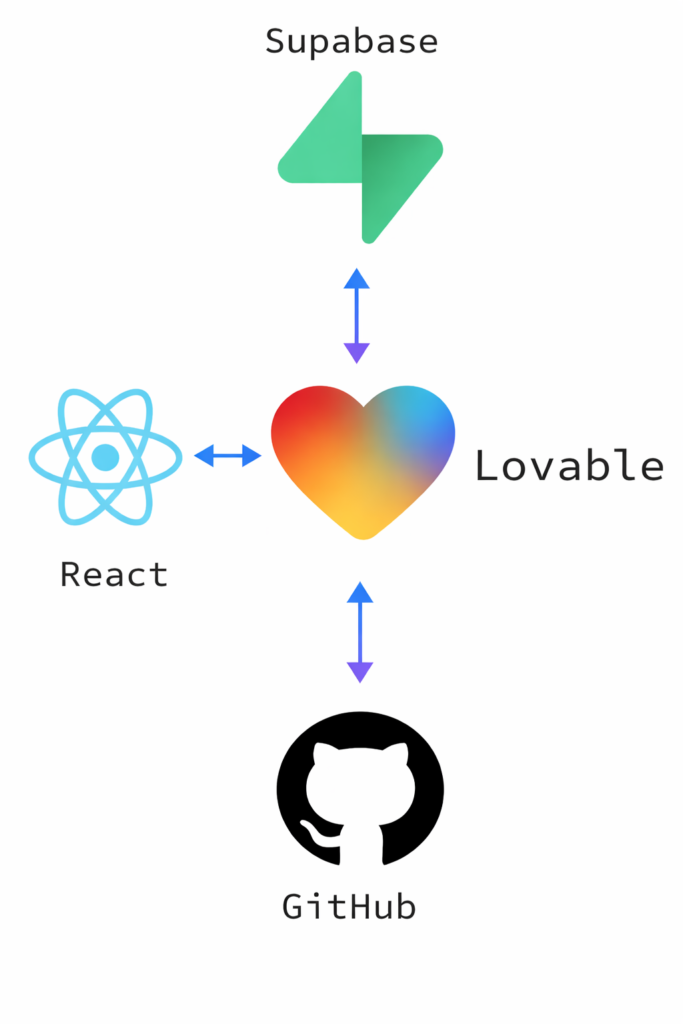
- A React-based user interface
- Backend logic and APIs powered by Supabase
- Database tables and relationships
- User authentication and access control
- A deployable project with a GitHub-ready codebase
For example, you might prompt:
“Design a fitness tracker web app with user auth, workout logging (exercises, sets, reps), progress charts, social sharing, and goal reminders.”
Within minutes, Lovable produces a live application with a React frontend, a Supabase backend, configured authentication, and a structured database. You can preview it instantly, test flows, and then refine the app by giving follow-up instructions in chat, like adding features or changing layouts.
The result is not a mockup or prototype. It is a real application you can export, edit, and deploy.
At the heart of the platform is what Lovable calls “vibe coding.” Users describe what they want the app to do in plain English, and the platform translates those instructions into real code. This removes the need to learn complex syntax upfront and makes app creation accessible to both developers and non-developers.
Also Read:
What is Replit AI?
Key Features of Lovable AI
Lovable AI stands out by combining AI-driven speed with real, developer-grade output. It is not a visual no-code builder. It is a code generator that produces usable full stack projects you can actually take over and ship.
1. Natural Language App Creation
Lovable lets you build applications by describing them in plain English. You can also upload screenshots or basic designs, and the platform translates that input into UI and code. This removes the need to start with syntax and setup, allowing you to focus on behavior and structure first.
2. Full Stack Code Generation
From a single prompt, Lovable generates a complete application. The frontend is built with React and Tailwind, while the backend runs on Node.js and Supabase. APIs, core logic, and infrastructure wiring are created automatically, giving you a working baseline without manual setup.
3. AI-Powered Logic and Workflows
Lovable automatically scaffolds common application logic such as CRUD operations, authentication, roles, payments, and API integrations. This covers the repetitive foundation most apps need, reducing time spent on boilerplate and basic wiring.
4. Rapid Prototyping and MVP Development
Lovable is designed for speed. It allows founders and builders to move from idea to prototype or MVP in minutes or hours instead of weeks. This makes it easier to validate ideas early and reduce the risk of overbuilding before user feedback.
5. Database and External API Integration
The platform includes native Supabase database integration, making it easy to work with live data. Lovable also supports connections to external APIs and third-party services, allowing apps to extend beyond simple static functionality.
6. One-Click Deployment
Lovable includes built-in hosting and deployment. Apps can be published instantly without configuring servers, pipelines, or DevOps tooling. This lowers the barrier to getting something live, especially for early-stage projects.
7. Visual and Design Integration
Apps can be generated using text prompts, screenshots, Figma imports, or Excalidraw sketches. Lovable attempts to respect layout structure, components, and branding, helping produce UIs that look more polished than typical auto-generated designs.
8. GitHub Integration and Code Ownership
All generated code is committed directly to your GitHub repository. This gives you full transparency and ownership, makes collaboration easier, and ensures you are not locked into a proprietary environment.
9. Editable and Extensible Codebase
Lovable generates clean, documented code that developers can modify using standard tools. You can refactor components, add custom logic, or extend functionality without fighting hidden abstractions.
10. AI Debugging and Pair Programming
Through chat mode, Lovable acts as an AI co-pilot. You can ask it to debug errors, inspect logs, refine features, or explain parts of the code. This is useful for iteration, though it still requires human review.
11. Real-Time Collaboration (Beta)
Lovable offers a multiplayer mode that allows teams to co-edit applications, share sessions, and collaborate in real time. This is especially useful for startups and product teams working together during early development.
12. Web and App Project Support
While optimized for full stack web applications, Lovable also supports simpler projects such as landing pages, portfolios, internal tools, and microsites. This makes it flexible for both product and non-product use cases.
13. Security and Scalability
Lovable includes basic automated security checks and a scalable project structure. Combined with GitHub export, this makes it easier to evolve the application as requirements grow, though advanced security still requires manual oversight.
14. Speed and Simplicity
Lovable prioritizes smart defaults, automation, and a low learning curve. The goal is to move from prompt to production quickly, without forcing users to manage unnecessary configuration or setup work.
How to Build an App with Lovable AI (Mini Tutorial)
Lovable AI follows a structured workflow that takes you from a raw idea to a fully functional full stack web application. Each step builds on the previous one, combining AI-driven planning with real code generation and developer control.
Step 1: Describe Your Application in Natural Language
The process starts with a prompt.
You describe your application idea, features, and basic behavior in plain English. This can include user roles, workflows, data you want to store, and how different parts of the app should interact.
Example prompt:
“Design a fitness tracker web app with user authentication, workout logging, progress charts, and goal reminders.”
Lovable analyzes this input to:
- Identify core entities such as users, workouts, exercises, and goals
- Understand required features like authentication, dashboards, and data visualization
- Infer data relationships between workouts, users, and progress metrics
- Plan pages, routes, and API requirements
This step sets the foundation. Clear prompts lead to cleaner architecture. Vague prompts still produce an app, but you will spend more time correcting assumptions later.
Step 2: Frontend Generation with React and Vite
Once the application plan is ready, Lovable generates the frontend.
Using React, it creates reusable UI components such as:
- Login and signup screens
- Workout logging forms
- Progress dashboards and charts
- Navigation menus and layouts
Vite is used as the build tool, enabling fast setup, instant hot reload, and optimized production builds.
The result is a responsive frontend you can preview immediately in the browser. These are real React components with proper routing and structure, not wireframes or placeholders.
Step 3: Backend and Database Setup Using Supabase
After the frontend is generated, Lovable configures the backend using Supabase.
Supabase provides:
- Email and password authentication
- User session management
- A PostgreSQL database
- Auto-generated APIs
- Row-level security rules
Based on the fitness tracker prompt, Lovable automatically:
- Creates tables for users, workouts, exercises, and progress data
- Defines relationships between workouts and authenticated users
- Sets up login and signup flows
- Connects frontend components to backend APIs
- Applies basic access control policies
You do not manually configure servers, write migrations, or build APIs. Lovable handles the setup so you can focus on how the product should behave.
Step 4: Review, Edit, and Refine the Codebase
Once generation is complete, Lovable exposes the full codebase.
You can browse:
- React components and pages
- Supabase configuration files
- Database schemas
- Environment variables
- Overall project structure
The code follows standard React and Supabase patterns. Beginners can use it as generated. Developers can refactor, extend, or optimize it.
You can also refine the app through chat with instructions such as:
- “Add weekly workout summaries.”
- “Create goal reminders with notifications.”
- “Improve the mobile dashboard layout.”
- “Fix the chart rendering issue.”
Lovable applies these changes across the relevant files automatically.
Nothing is hidden behind proprietary layers. You always work with real, editable code.
Step 5: Export, Deploy, and Continue Development
When the app is ready, you can export the project to GitHub.
This allows you to:
- Run the app locally in VS Code or Cursor
- Commit changes and manage versions
- Collaborate with other developers
- Deploy to platforms like Vercel or Netlify
- Add external services such as payments or email
At this point, the app is a standard full stack project. Lovable is optional. You keep full ownership of the code and deployment, with no vendor lock-in.
Real-World Use Cases of Lovable AI
Lovable AI is best suited for builders who need to move fast while keeping control of their code. It works well when time, budget, or team size is limited.
Startups and Founders
Founders use Lovable to build MVPs quickly and test ideas with real users. It helps create live demos for investors, iterate faster based on feedback, and avoid heavy upfront engineering costs.
Freelancers and Agencies
Freelancers and agencies use Lovable as a rapid prototyping tool. It helps them create initial versions of apps, reduce repetitive setup work, and focus more on client-specific features and customization.
Small and Mid-Sized Businesses
SMBs use Lovable to build internal tools without hiring large engineering teams. Common use cases include dashboards, simple CRMs, reporting systems, and workflow tools.
Individual Creators
Solo builders use Lovable to turn ideas into working apps. This includes productivity tools, portfolios, learning projects, and early SaaS experiments.
Creative and Experimental Projects
Lovable is also useful for quick experiments. Creators use it to build interactive tools, small apps, and concept products when speed matters more than polish.
Pricing of Lovable.dev
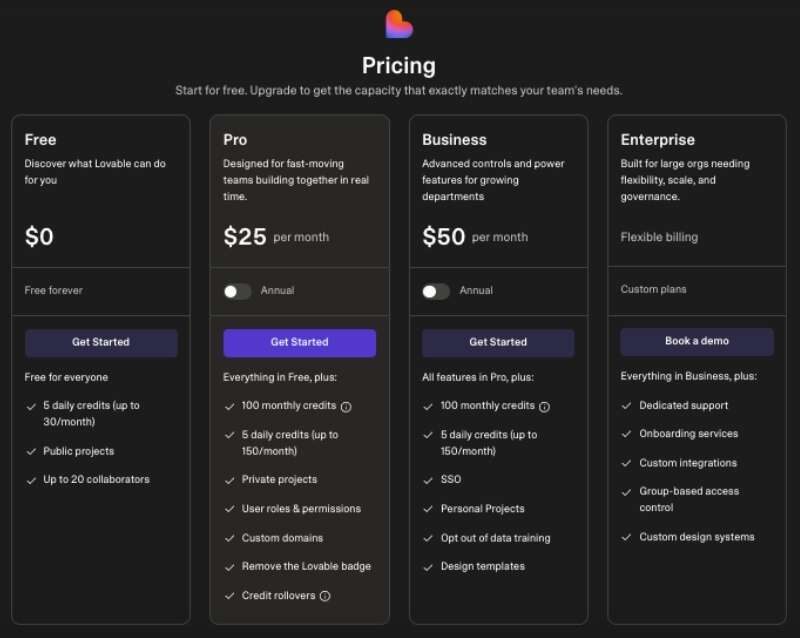
Lovable AI uses a credit-based pricing model with plans designed for individuals, teams, and enterprises. The right plan depends less on features and more on how often you rely on AI-generated changes.
Free Plan
The Free plan is for exploration, not production.
It includes limited daily credits, public projects, Lovable branding, and unlimited collaborators. This plan is useful for testing ideas and understanding how the platform works, but it is not practical for building or maintaining real products.
Pro Plan
The Pro plan is built for active builders.
It offers higher monthly credit limits, daily credit refills, custom domains, branding removal, and access to more AI resources. This is the plan most founders and freelancers end up using once they move beyond experimentation.
Business Plan
The Business plan is designed for teams.
It adds private projects, internal publishing, SSO support, and team access controls. This plan makes sense when Lovable becomes part of a shared workflow rather than a solo tool.
Enterprise Plan
Enterprise pricing is custom and sales-led.
It typically includes dedicated support, private or custom hosting, custom integrations, and larger credit pools. This plan is intended for organizations with strict security, compliance, or scale requirements.
Credit Usage Reality Check
Lovable looks affordable at a monthly level, but credit usage is where costs can creep up. Frequent regeneration of features, layouts, or logic consumes credits quickly. Teams that rely heavily on iteration should plan usage carefully instead of treating credits as unlimited.
Alternatives to Lovable AI
The following table compares Lovable AI with other popular app development platforms, based on who they are best suited for, how they work, and how they are priced.
| Tool | Best For | Key Capabilities | Pricing |
|---|---|---|---|
| Lovable AI | Developers, startups, agencies | Full-stack app generation, React + Supabase code, GitHub integration, AI logic for CRUD and auth, real-time collaboration | Free, ~$25/month, ~$50/month |
| UI Bakery | Developers, agencies, enterprises | Visual UI builder, frontend customization, internal tools, real-time collaboration | Contact for pricing |
| OutSystems | Large enterprises | Enterprise-grade full-stack development, rapid deployment, cross-platform support, deep backend integrations | Contact for pricing |
| Bubble | Entrepreneurs, no-code builders | Drag-and-drop UI, no-code backend logic, workflows, collaboration | Free, paid plans from ~$25/month |
| bolt.new | Founders, rapid prototyping | AI-first prompt-to-app builder, fast MVP generation, minimal setup | Usage-based / evolving pricing |
| GitHub (Copilot + Codespaces) | Professional developers | Prompt-assisted coding, full control over code, cloud dev environments, collaboration | Free tier, paid Copilot plans |
| Cursor | Developers | AI-native code editor, natural language coding, real-time debugging, IDE-level control | Free, paid plans available |
| v0.dev | Designers, frontend developers | Prompt-to-UI generation, React + Tailwind components, UI-first output | Free tier, paid plans |
Final Verdict : Is Lovable AI Worth the Hype?
Lovable AI does exactly what it promises. It helps you go from an idea in plain English to a working app faster than traditional development ever allows. You do not have to wrestle with setup, infrastructure, or boilerplate just to see something live.
That said, it is not magic. Lovable will not think through your product decisions for you, and complex apps will still need hands-on customization. The speed is real, but the responsibility for quality stays with you.
If you are a founder testing an idea, a builder prototyping fast, or a team creating internal tools, Lovable can save you a huge amount of time. Use it to move quickly, learn early, and decide what is worth building further.
Curious how far you can go with a single prompt?
Drop your thoughts or questions in the comments!!