

If you thought only music apps were allowed to summarize your life choices, think again. OpenAI has officially joined the year-end nostalgia economy. The company is rolling out a new feature for ChatGPT called “Your Year with ChatGPT,” a personalized annual recap clearly modeled on the cultural juggernaut known as Spotify Wrapped.
This is not a subtle inspiration. It is deliberate. And honestly, it makes complete sense.
The feature is now live for eligible users in select markets, starting with the United States and extending to other English-speaking regions including Canada, the United Kingdom, Australia, and New Zealand. If you are outside these regions, you are not missing out because this rollout is controlled, limited, and very intentional.
Who Gets Access and Who Does Not
Let us cut through the noise first.
“Your Year with ChatGPT” is available to users on the Free, Plus, and Pro plans. That sounds generous until you read the fine print, which most people do not.
To qualify, users must have both reference saved memories and reference chat history turned on. On top of that, users must meet a minimum conversation activity threshold. OpenAI has not disclosed the exact number, which tells you everything you need to know. If you barely used ChatGPT this year, you are out.
And before enterprise users get excited, stop. Team, Enterprise, and Education accounts are explicitly excluded from this experience. This feature is consumer-facing by design. It is not meant for compliance-heavy environments or shared workspaces. OpenAI wants personal data, personal context, and personal patterns. That does not exist in enterprise setups.
According to OpenAI, the experience is meant to be lightweight, privacy-forward, and user-controlled. Those words sound comforting, but let us be real. This feature exists because user behavior data is now a product layer, not just an internal metric.
What the Feature Actually Shows You
If you are expecting a cold analytics dashboard with charts and percentages, you will be disappointed. This is not a data export. It is storytelling.
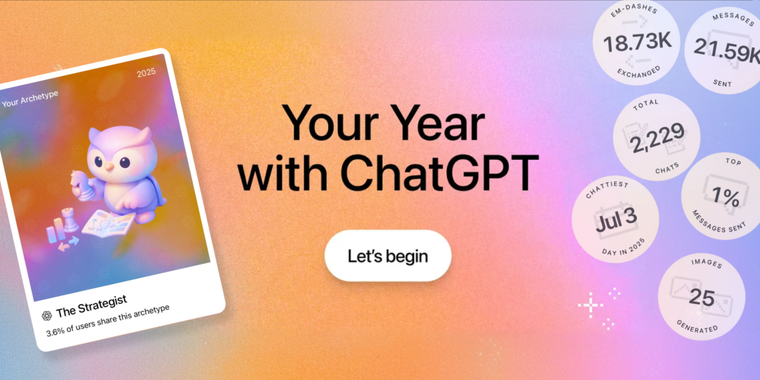
Just like Spotify Wrapped, “Your Year with ChatGPT” presents your usage through visually engaging slides, playful summaries, and personality-driven labels. Instead of showing how many prompts you typed, it frames how you used the tool.
You might receive an award like “Creative Debugger” if you consistently asked ChatGPT to solve problems, untangle concepts, or brainstorm solutions. Others may see titles related to learning, writing, planning, or ideation, depending on their behavior.
This is not accidental. Labels like these are designed to reinforce identity. OpenAI is not just telling you what you did. It is telling you who you are, at least within the ChatGPT ecosystem. That matters.
Poems, Images, and Emotional Hooks
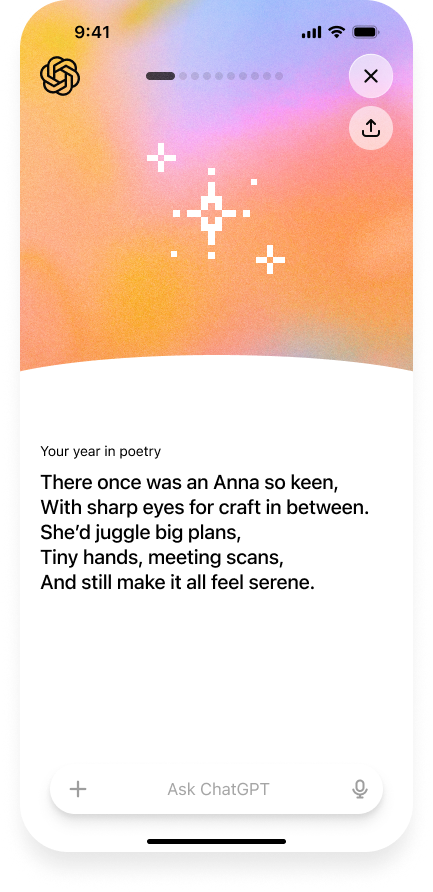
The feature goes a step further by generating a poem and an image that reflect your year with ChatGPT, based on your dominant topics of interest. This is where the product quietly flexes its generative muscle.
It is also where things get interesting and potentially weird in the future.
Today, the content is safe, polished, and broadly appealing. But as ChatGPT expands its content boundaries and capabilities over time, including more mature and nuanced domains, these personalized creative outputs could become far more revealing than users expect.
For now, OpenAI is playing it safe. The experience is optional, never forced, and not opened automatically. Users can ignore it completely or trigger it manually by asking ChatGPT directly for “Your Year with ChatGPT.”
That choice is smart. Forced nostalgia backfires.
Where and How You Can Access It
The year-end review appears as a prompt on the ChatGPT home screen, but it does not hijack the interface. Users can also access it through both the web app and the mobile apps on iOS and Android.
This cross-platform availability is critical. OpenAI wants this to feel universal, not tied to a single device or use case. Whether you primarily use ChatGPT at work, at night on your phone, or casually in a browser, the experience follows you.
That continuity is part of the strategy.
Why OpenAI Is Doing This Now
Let us not pretend this is just a fun holiday feature.
Spotify Wrapped works because it turns passive usage into an emotional artifact. People share it. They talk about it. They identify with it. And every share becomes free marketing.
OpenAI wants the same effect. ChatGPT has crossed from being a tool into being a habit. For many users, it is where they think, plan, write, and problem-solve. A year-end recap reframes that habit as a relationship. You did not just use ChatGPT. You spent a year with it.
That language is intentional and slightly uncomfortable if you think about it too long.
This feature also subtly normalizes long-term memory and history-based personalization. If users enjoy the recap, they are less likely to disable chat history and saved memories in the future. That data fuels better personalization, better retention, and better product decisions.
This is product psychology 101.
How It Compares to Spotify Wrapped
The comparison to Spotify Wrapped is unavoidable and frankly earned.
Both experiences take raw behavioral data and turn it into something celebratory. Both rely on visuals, humor, and light gamification. Both encourage sharing, even if OpenAI has not pushed social sharing as aggressively yet.
The difference is context.
Spotify Wrapped summarizes entertainment consumption. ChatGPT’s year-end review summarizes thinking patterns, problem-solving habits, and intellectual curiosity. That is a much more intimate dataset.
Spotify tells you what you listened to.
ChatGPT tells you how you think.
That is a powerful shift.
What This Signals for the Future of AI Products
This launch is not just about a year-end recap. It signals where AI consumer products are headed.
AI tools are no longer positioning themselves purely as utilities. They are becoming companions, mirrors, and narrative devices. Features like “Your Year with ChatGPT” are designed to humanize the product while deepening user lock-in.
Expect more of this.
Monthly summaries. Personal milestones. Progress reflections. Creative retrospectives. All of it wrapped in friendly language and soft visuals.
If you think this is harmless fun, you are only half right. It is fun, yes. But it is also strategic, data-driven, and very intentional.
Final Take
“Your Year with ChatGPT” is not revolutionary. It is not technically impressive. It is not solving a new problem.
What it is doing is far more important. It reframes ChatGPT from a tool you use into an experience you remember. And that is exactly how products stop being optional.
If OpenAI executes this well and evolves it carefully, this feature will become a yearly ritual for millions of users. If it overreaches, it risks feeling invasive. For now, it walks the line well. And that is not an accident.